Mexico is beginning a five-day shutdown of parts of its economy in a bid to slow the spread of swine flu.
Non-essential government services will stop, while businesses like cinemas and restaurants will be shut. Traditional May Day rallies have been cancelled.
Mexican officials say the spread of the virus - suspected in more than 160 deaths - is slowing, but international experts are more cautious.
Swine flu cases have now been confirmed in 12 countries over three continents.
In cases outside Mexico the virus does not appear to be severe, although one death has been confirmed in the US.
The WHO has set its pandemic alert level at five - but says it has no immediate plans to move to the highest level of six.
Economy fears
The shut-down in Mexico covers two public holidays and a weekend.
Some factories will stop production and schools are already closed. Residents have been urged to stay at home.
But some people say they will ignore it because they cannot afford not to work.
There is also growing concern at the effect the virus could have on Mexico's already-struggling economy.
The number of confirmed cases of swine flu infection in Mexico now stands at about 300, officials say.
Twelve people are known to have died from the virus and it is suspected in more than 160 other deaths.
Announcing the figures, Mexican Health Secretary Jose Angel Cordova said that new cases of the virus were levelling off.
"The fact that we have a stabilisation in the daily numbers, even a drop, makes us optimistic," he said.
But Dr Keiji Fukuda, acting assistant director general of the World Health Organisation, said fluctuations were to be expected. "If it didn't do that [it] would be very unusual," he said.
In other developments:
• The US has announced that it will buy 13 million new courses of antiviral treatment and send 400,000 of them to Mexico
• An aide to US Energy Secretary Stephen Chu who helped arrange President Obama's recent trip to Mexico is being tested for swine flu, AP reports, although the aide is said not to have been in contact with the president
• German authorities confirm that a nurse who treated a patient with swine flu also contracted the disease, in the first person-to-person transmission in the country
• Test results are expected to confirm the UK's first person-to-person transmission of swine flu, in a friend of a couple from Scotland who were first in the country to be diagnosed with the virus
• Mexico says it will lodge a formal challenge at the World Trade Organisation demanding explanations from countries that have banned imports of Mexican pork products
'No panic'
On Thursday European health ministers held an emergency meeting on measures to tackle the virus, which has been confirmed in six European countries.
EU Health Commissioner Androulla Vassiliou said Europe was well prepared to handle swine flu and there was "no need to panic".
The ministers agreed to work with pharmaceutical companies to develop a vaccine, but rejected a French plan to suspend flights to Mexico.
Several countries have restricted travel to Mexico and many tour operators have cancelled holidays.
The WHO, meanwhile, says it will now call the virus influenza A (H1N1) rather than swine flu - which it says is misleading as pork meat is safe and the virus is being transmitted from human to human.
Source: Swine Influenza Top News
Showing posts with label Swine Flu Outbreak. Show all posts
Showing posts with label Swine Flu Outbreak. Show all posts
WHO PANDEMIC ALERT PHASES

Phase 1: No infections in humans are being caused by viruses circulating in animals.

Phase 2: Animal flu virus causes infection in humans, and is a potential pandemic threat.

Phase 3: Flu causes sporadic cases in people, but no significant human-to-human transmission.

Phase 4: Human-to-human transmission and community-level outbreaks.

Phase 5: Human-to-human transmission in at least two countries. Strong signal pandemic
imminent.

Phase 6: Virus spreads to another country in a different region. Global pandemic under way.

Post-peak: Pandemic activity appears to be decreasing though second wave possible.
Post-pandemic: activity returns to normal, seasonal flu levels.
Source: Swine Influenza Top News
How Swine Flu Outbreak Emerged
Cases of swine flu, which has killed people in Mexico, have been confirmed around the world. With experts scrambling to develop a vaccine, there is concern at the potential for a pandemic affecting millions of people.
What is swine flu?
Swine flu is a respiratory disease, caused by influenza type A which infects pigs.
There are many types, and the infection is constantly changing.
Until now it has not normally infected humans, but the latest form clearly does, and can be spread from person to person - probably through coughing and sneezing.
What is new about this type of swine flu?
The World Health Organization has confirmed that at least some of the human cases are a never-before-seen version of the H1N1 strain of influenza type A.
H1N1 is the same strain which causes seasonal outbreaks of flu in humans on a regular basis.
But this latest version of H1N1 is different: it contains genetic material that is typically found in strains of the virus that affect humans, birds and swine.
Flu viruses have the ability to swap genetic components with each other, and it seems likely that the new version of H1N1 resulted from a mixing of different versions of the virus, which may usually affect different species, in the same animal host.
Pigs provide an excellent 'melting pot' for these viruses to mix and match with each other.
How dangerous is it?
Symptoms of swine flu in humans appear to be similar to those produced by standard, seasonal flu.
These include fever, cough, sore throat, body aches, chills and fatigue.
It is worth remembering that seasonal flu often poses a serious threat to public health: each year it kills 250,000 - 500,000 around the world.
So far, most cases of swine flu around the world appear to be mild, albeit with diarrhoea more common than it is with seasonal flu.
But lives have been lost in Mexico, and a single death - of a Mexican child - has been confirmed in the US.
How worried should people be?
When any new strain of flu emerges that acquires the ability to pass from person to person, it is monitored very closely in case it has the potential to spark a global epidemic, or pandemic.
The World Health Organization has warned that swine flu could potentially trigger a global pandemic, and stress that the situation is serious.
However, experts say it is still too early to accurately assess the situation fully.
Currently, they say the world is closer to a flu pandemic than at any point since 1968 - upgrading the threat from four to five on a six-point scale following a meeting on Wednesday.
This means all governments have to mobilise their pandemic flu plans.
Nobody knows the full potential impact of a pandemic, but experts have warned that it could cost millions of lives worldwide. The Spanish flu pandemic, which began in 1918, and was also caused by an H1N1 strain, killed millions of people.
There is hope that, as humans are often exposed to forms of H1N1 through seasonal flu, our immune systems may have something of a head start in fighting infection.
However, the fact that many of the victims are young does point to something unusual. Normal, seasonal flu tends to affect the elderly disproportionately
Is Mexico different?
The death toll in Mexico - where the virus at present seems to producing much more severe symptoms - suggests there may be unusual factors coming into play there.
Some experts have suggested the possibility that other, unrelated viruses may also be circulating in Mexico, making symptoms worse.
This would be unlikely to come into play in the rest of the world.
Alternatively, people infected in Mexico may have sought treatment at a much later stage than those in other countries.
It may also be the case that the form of the virus circulating in Mexico is subtly different to that elsewhere - although that will only be confirmed by laboratory analysis.
The Mexican authorities have downgraded the official death toll from the virus, ordering a new round of more stringent tests.
Can the virus be contained?
The virus appears already to have started to spread around the world, and most experts believe that, in the era of readily available air travel, containment will be extremely difficult.
The World Health Organization says that restricting flights will have little effect. It argues that screening of passengers is also unlikely to have much impact, as symptoms may not be apparent in many infected people.
Can it be treated?
The US authorities say that two drugs commonly used to treat flu, Tamiflu and Relenza, seem to be effective at treating cases that have occurred there so far. However, the drugs must be administered at an early stage to be effective.
Use of these drugs may also make it less likely that infected people will pass the virus on to others.
The UK Government already has a stockpile of Tamiflu, ordered as a precaution against a pandemic.
It is unclear how effective currently available flu vaccines would be at offering protection against the new strain, as it is genetically distinct from other flu strains.
A new bespoke vaccine is being worked on by scientists in the UK and the US, but it may take months to perfect it, and manufacture enough supplies to meet what could be huge demand.
A vaccine was used to protect humans from a version of swine flu in the US in 1976.
However, it caused serious side effects, including an estimated 500 cases of Guillain-Barré syndrome. There were more deaths from the vaccine than the outbreak.
What should I do to stay safe?
Anyone with flu-like symptoms who might have been in contact with the swine virus - such as those living or travelling in the areas of Mexico that have been affected - should seek medical advice.
But patients are being asked not to go into GP surgeries in order to minimise the risk of spreading the disease to others. Instead, they should stay at home and call their healthcare provider for advice.
Countries around the world have taken varying measures but are mostly stepping up monitoring and issuing advice about travel to Mexico.
In the UK, the Foreign Office is advising against all but essential travel to Mexico.
What measures can I take to prevent infection?
Avoid close contact with people who appear unwell and who have fever and cough.
General infection control practices and good hygiene can help to reduce transmission of all viruses, including the human swine influenza. This includes covering your nose and mouth when coughing or sneezing, using a tissue when possible and disposing of it promptly.
It is also important to wash your hands frequently with soap and water to reduce the spread of the virus from your hands to face or to other people and cleaning hard surfaces like door handles frequently using a normal cleaning product.
If caring for someone with a flu-like illness, a mask may be worn to cover the nose and mouth to reduce the risk of transmission. The UK is looking at increasing its stockpile of masks for healthcare workers for this reason.
In Mexico masks have been handed out to the general public, but experts are sceptical about how useful this is.
May it take some time for a pandemic to strike?
Possibly. The flu virus tends to thrive in cooler conditions, and to struggle in warmer weather.
The initial cases have developed right at the tail end of the winter flu season in the northern hemisphere, so it is possible that the number of infections may only begin to accelerate once the weather turns colder in the autumn.
However, the southern hemisphere is about to enter its winter season and it is possible that the virus will take hold there first.
Is it safe to eat pig meat?
Yes. There is no evidence that swine flu can be transmitted through eating meat from infected animals.
However, it is essential to cook meat properly. A temperature of 70C (158F) would be sure to kill the virus.
Experts are also stressing that this is now a disease which is being passed between people.
The World Organisation for Animal Health said culling pigs, as Egypt has proposed, was therefore "inappropriate" as a measure to stop swine flu spreading.
It added there was no evidence of infection in pigs, nor of humans acquiring infection directly from pigs.
What about bird flu?
The strain of bird flu which has caused scores of human deaths in South East Asia in recent years is a different strain to that responsible for the current outbreak of swine flu.
The latest form of swine flu is a new type of the H1N1 strain, while bird, or avian flu, is H5N1.
Experts fear H5N1 holds the potential to trigger a pandemic because of its ability to mutate rapidly.
However, it has so far remained very much a disease of birds.
Those humans who have been infected have, without exception, worked closely with birds, and cases of human-to-human transmission are extremely rare. There is no suggestion that H5N1 has gained the ability to pass easily from person to person.
Where can I get further advice?
Further information and advice on swine flu can be found at websites of leading health and research organisations around the world. The World Health Organisation gives background information on the virus.
The UK's government services website is carrying regularly updated health and travel information. The Health Protection Agency advises the public about what to do if returning from an affected area. NHS Choices outlines how swine flu is different from other flu.
The US government's Centre for Disease Control is counting the number of cases in the US.
You can also track the spread of swine flu reports using unofficial sources. Google is mapping search term data as an indicator of flu activity both across the US down to state level and in Mexico. Healthmaps maps viruses using news reports. Social media guide Mashable lists a range of ways to track the virus .
Information and links to useful websites are being shared on Twitter, the micro-blogging service, while social networking website Facebook is tracking swine flu discussion amongst users.
Further questions from our readers have been answered by a UK-based expert.
Source: Swine Influenza Top News
Different species harbour different strains of the flu virus...
For the example:

Flu viruses mutate over time causing small changes to proteins on their surface called antigens. If the immune system has met a particular strain of the virus before, it is likely to have some immunity; but if the antigens are new to the immune system, it will be weakened.

The influenza A virus can mutate in two different ways; antigenic drift, in which existing antigens are subtly altered, and antigenic shift, in which two or more strains combine. Antigenic drift causes slight flu mutations year on year, from which humans have partial, but not complete, immunity. By contrast, the new strain of H1N1 appears to have originated via antigenic shift in Mexican pigs

The name "swine flu" is a slight misnomer as it is believed pigs acted as a mixing pot for several flu strains, containing genetic material from pigs, birds and humans. Most humans have never been exposed to some of the antigens involved in the new strain of flu, giving it the potential to cause a pandemic.
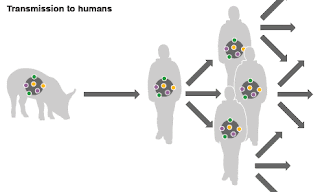
The new virus has made the jump from pigs to humans and has demonstrated it can also pass from human to human. This is why it is demanding so much attention from health authorities. The virus passes from human to human like other types of flu, either through coughing, sneezing, or by touching infected surfaces, although little is known about how the virus acts on humans.
Source: Swine Influenza Top News

Flu viruses mutate over time causing small changes to proteins on their surface called antigens. If the immune system has met a particular strain of the virus before, it is likely to have some immunity; but if the antigens are new to the immune system, it will be weakened.

The influenza A virus can mutate in two different ways; antigenic drift, in which existing antigens are subtly altered, and antigenic shift, in which two or more strains combine. Antigenic drift causes slight flu mutations year on year, from which humans have partial, but not complete, immunity. By contrast, the new strain of H1N1 appears to have originated via antigenic shift in Mexican pigs

The name "swine flu" is a slight misnomer as it is believed pigs acted as a mixing pot for several flu strains, containing genetic material from pigs, birds and humans. Most humans have never been exposed to some of the antigens involved in the new strain of flu, giving it the potential to cause a pandemic.

The new virus has made the jump from pigs to humans and has demonstrated it can also pass from human to human. This is why it is demanding so much attention from health authorities. The virus passes from human to human like other types of flu, either through coughing, sneezing, or by touching infected surfaces, although little is known about how the virus acts on humans.
Source: Swine Influenza Top News
Swine influenza 2009 swine flu outbreak
The 2009 swine flu outbreak is an epidemic that began in April 2009 with a new strain of influenza virus. The new strain is commonly called swine flu, but some authorities object to the name and it is also called Mexican flu, swine-origin influenza, North American influenza, and 2009 H1N1 flu. The outbreak is believed to have started in March 2009 and was classified as meeting the criteria for the World Health Organization pandemic Phase 5 status on 29 April. Local outbreaks of an influenza-like illness were first detected in three areas of Mexico, but the virus responsible was not clinically identified as a new strain until April 24, 2009. Following the identification, its presence was soon confirmed in various Mexican states and in Mexico City. Within days, isolated cases (and suspected cases) were identified elsewhere in Mexico, the U.S., and several other Northern Hemisphere countries.
By April 28, the new strain was confirmed to have spread to Spain, the United Kingdom, New Zealand, and Israel, and the virus was suspected in many other nations, with a total of over 3,000 candidate cases, prompting the World Health Organization (WHO) to change its pandemic alert phase to "Phase 5", which denotes "widespread human infection". Despite the scale of the alert, the WHO stated on April 29 that the majority of people infected with the virus have made a full recovery without need of medical attention or antiviral drugs.
The new strain is an apparent reassortment of four strains of influenza A virus subtype H1N1. Analysis at the United States Centers for Disease Control and Prevention (CDC) identified the four component strains as one endemic in humans, one endemic in birds, and two endemic in pigs (swine). One swine strain was widespread in the United States, the other in Eurasia.
In late April both the United Nations WHO and the U.S. CDC expressed serious concern about the situation, as it had the potential to become a flu pandemic due to the novelty of the influenza strain, its transmission from human to human, and the unusually high mortality rate in Mexico. On April 25, 2009, the WHO formally determined the situation to be a "public health emergency of international concern", with knowledge lacking in regard to "the clinical features, epidemiology, and virology of reported cases and the appropriate responses". Government health agencies around the world also expressed concerns over the outbreak and are monitoring the situation closely.
On April 24, 2009, Mexico's schools, universities, and all public events were closed until May 6, 2009. On April 27, 2009, a few schools in the U.S. closed due to confirmed cases in students. On April 29, 2009 18 more U.S. schools shut down as the disease became more widespread in the U.S.
Source: Swine Influenza Top News
By April 28, the new strain was confirmed to have spread to Spain, the United Kingdom, New Zealand, and Israel, and the virus was suspected in many other nations, with a total of over 3,000 candidate cases, prompting the World Health Organization (WHO) to change its pandemic alert phase to "Phase 5", which denotes "widespread human infection". Despite the scale of the alert, the WHO stated on April 29 that the majority of people infected with the virus have made a full recovery without need of medical attention or antiviral drugs.
The new strain is an apparent reassortment of four strains of influenza A virus subtype H1N1. Analysis at the United States Centers for Disease Control and Prevention (CDC) identified the four component strains as one endemic in humans, one endemic in birds, and two endemic in pigs (swine). One swine strain was widespread in the United States, the other in Eurasia.
In late April both the United Nations WHO and the U.S. CDC expressed serious concern about the situation, as it had the potential to become a flu pandemic due to the novelty of the influenza strain, its transmission from human to human, and the unusually high mortality rate in Mexico. On April 25, 2009, the WHO formally determined the situation to be a "public health emergency of international concern", with knowledge lacking in regard to "the clinical features, epidemiology, and virology of reported cases and the appropriate responses". Government health agencies around the world also expressed concerns over the outbreak and are monitoring the situation closely.
On April 24, 2009, Mexico's schools, universities, and all public events were closed until May 6, 2009. On April 27, 2009, a few schools in the U.S. closed due to confirmed cases in students. On April 29, 2009 18 more U.S. schools shut down as the disease became more widespread in the U.S.
Source: Swine Influenza Top News
Subscribe to:
Posts (Atom)

 Posts
Posts


